Brakes
What Brake Repair Costs for Nashua Drivers: Pads, Rotors, and Full Jobs Explained
Why does one brake quote say $250 and the next $900 for the "same" job? Here's what pads, rotors, and a full brake job actually cost — and the common mistakes that quietly double the bill.
9 min readPro Tech Auto, Manchester NH
If you've called around for brake quotes in the Nashua area, you've probably had the confusing experience of hearing three very different numbers for what sounds like the same job. One shop says $180 an axle. The next says $450. A third quotes $900 and starts talking about calipers and fluid. None of them are necessarily wrong — they're just quoting different work, and it's almost impossible to tell which one you actually need over the phone.
This is a guide to what brake repair really costs, written to help you compare quotes honestly. We'll break down pads-only, pads-and-rotors, and a full brake job, explain what drives the price up or down, and walk through the common mistakes that turn a routine brake service into an expensive one. Nashua sits about fifteen minutes south of our Manchester bay, and we see the same salt, same short winter commutes, and the same brake patterns on cars from both towns.
The three brake jobs — and why the prices differ so much
Almost every brake quote is really one of three jobs. Knowing which one you're being sold is the single most useful thing you can do before you pay.
1. Pads only
The cheapest and most common. New pads go on, the rotors stay. This is the right call when the rotors are still within the manufacturer's minimum thickness spec and their surface is smooth. On a typical car, a quality pad-only job on one axle usually lands in the low-to-mid hundreds, parts and labor combined — front axle a bit more than rear because front brakes do most of the work. If someone quotes you well under a hundred dollars an axle, ask what pads they're using and whether the rotors were measured.
2. Pads and rotors
The most common job we actually perform, because by the time most drivers call, the rotors are already too thin or too grooved to reuse. Replacing pads and rotors together on one axle commonly runs somewhere in the mid-to-high hundreds per axle depending on the vehicle. A common domestic sedan is at the low end; a loaded SUV, a truck, or a European car with larger rotors is at the high end. Doing all four corners at once roughly doubles that.
3. A full brake job
This is pads and rotors plus the parts that fail alongside them — calipers, caliper hardware and slide pins, brake hoses, and a brake fluid flush. You don't always need all of it, but on a high-mileage New Hampshire car that's spent years in road salt, one or more of these is often the reason the brakes failed early in the first place. A full job on a badly neglected car can climb past a thousand dollars, and skipping the failed part to save money is exactly how people end up paying twice.
What actually drives the price up or down
Two identical-looking cars can have brake bills hundreds of dollars apart. Here's what moves the number:
- Pad quality. Economy pads are cheaper up front but wear faster, dust more, and are often noisier. Premium ceramic or OE-spec pads cost more but last longer and stop quieter — usually the better value on a car you plan to keep.
- Rotors: resurface vs. replace. Rotors can sometimes be machined smooth if they're thick enough, but modern rotors are made thin to save weight and often can't be cut safely. On most newer cars, replacement is the honest answer — and once you price the labor, new rotors are frequently cheaper than machining old ones.
- Front vs. rear. Front brakes handle 60–70% of stopping and wear faster, so fronts come up more often and can be pricier if calipers or bigger rotors are involved.
- Salt damage. This is the big NH-specific one. Seized caliper slide pins, corroded hardware, and rusted brake lines add parts and labor that a dry-climate car never needs.
- Vehicle type. Larger rotors, performance brakes, and electronic parking brakes (which need a scan tool to retract the rear calipers) all add cost — this is where European and luxury vehicles run higher.

Do you actually need rotors, or just pads?
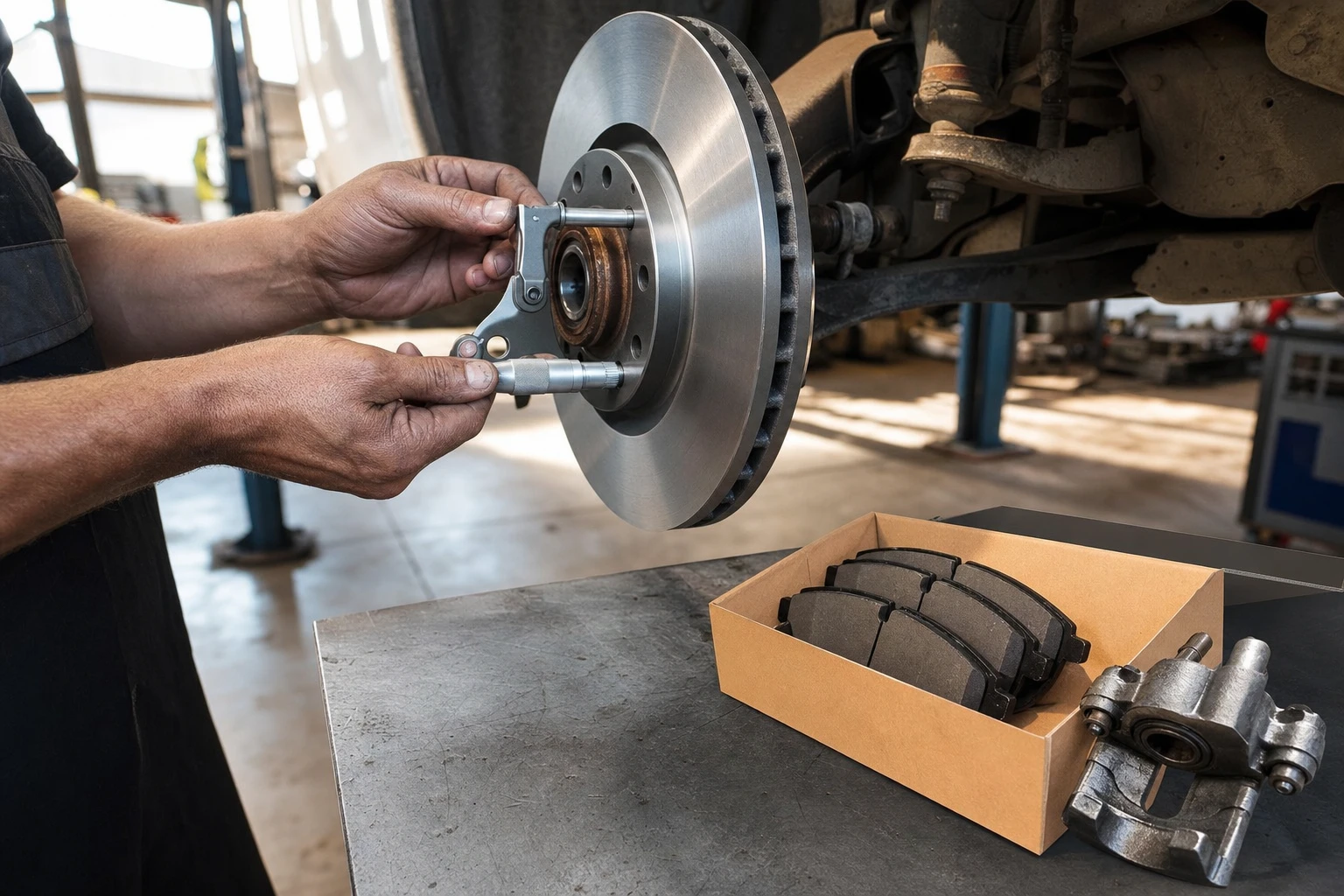
This is where most of the price confusion — and most of the mistakes — live. Rotors get replaced for three real reasons: they're worn below minimum thickness spec, they're grooved or scored from worn-out pads running metal-on-metal, or they have uneven thickness that causes a pulsing pedal. A good shop measures the rotor with a micrometer and shows you the number against the spec stamped on the rotor itself. If a shop can't tell you the measurement, they're guessing — in either direction.
The flip side is also true: some shops replace rotors on every job automatically because it's faster and more profitable than measuring. If your pads were caught early — squealing from the wear indicator rather than grinding — there's a real chance your rotors are fine and you only need pads. The way to know is a measurement, not a sales pitch. If the noise has moved to a grinding or growling sound, though, assume the rotors are going too; that sound is the pad backing plate cutting into the rotor. We cover how to read those noises in our guide to the brake warning signs every NH driver should know before winter.
The common mistakes that cost Nashua drivers the most
Mistake 1: Chasing the cheapest quote
The lowest number almost always leaves something out — bargain pads, no hardware, no fluid flush, no caliper service. You feel good about the invoice and then you're back in a year with a squeal or a pulsing pedal. The right question isn't "who's cheapest?" It's "what's included, and what did you measure?"
Mistake 2: Pads on top of bad rotors
Slapping new pads onto scored or warped rotors is the single most common corner-cut. The new pads can't seat evenly against a damaged surface, so you get noise, vibration, and pads that wear out fast. It looks cheaper on day one and costs more within months.
Mistake 3: Ignoring the caliper and hardware
A seized caliper slide pin makes one pad drag and wear out in a couple thousand miles. If a shop replaces your pads but doesn't clean and lubricate the slides — the step chain shops skip most often — the new pads can be half gone before the season's out. On a salt-belt car, caliper and hardware service isn't an upsell; it's the reason the job lasts.
Mistake 4: Skipping the brake fluid
Brake fluid absorbs moisture over time, which lowers its boiling point and corrodes the system from the inside. Most manufacturers want it flushed every two to three years, and it's one of the cheapest things on the whole list. Skip it for a decade and you're not saving money — you're setting up a master cylinder or ABS repair that costs far more than the flush would have.
Mistake 5: Driving on a grinding or sinking pedal
The most expensive mistake of all. A squeal caught early is a pad job. Left until it grinds, it's pads and rotors. Left until the pedal sinks to the floor, it can be calipers, lines, or a hydraulic failure that never should have happened. Brakes are the one system where waiting reliably multiplies the bill.
How to compare brake quotes like a pro
When you've got two or three numbers in hand, don't line them up by price. Line them up by scope. Ask each shop the same questions and the right choice usually becomes obvious:
- Did you measure the rotors, and what was the number versus minimum spec?
- What pads are you quoting — economy, premium, or OE-spec?
- Is caliper hardware (slide pins, clips) cleaned and lubricated, or replaced?
- Is a brake fluid flush included, and when was mine last done?
- Is the quote per axle or for all four corners?
- Will I get a written estimate before work starts, and do you check with me if you find something extra?
A shop that answers those clearly and puts it in writing is quoting you a repair. A shop that dodges them and just repeats a low number is quoting you a parts sale. The first invoice might be higher — the total cost of ownership almost always ends up lower.
How we price brakes at Pro Tech Auto
Our approach is the same one we bring to every repair: test before we recommend, and never start work until you've signed off on the scope and the price. When a car comes in for brakes, we pull all four wheels, measure the rotors against spec, inspect the calipers, hoses, and hardware, and check the fluid. Then you get a plain-English estimate that shows exactly what needs doing now, what can safely wait, and what it costs — with no bargain-bin parts and no surprise line items on the final invoice.
Brakes fall under our full menu of repair services, and because the same salt that eats brakes in Nashua eats them in Manchester, we see these jobs constantly on both domestic and European cars. The cheapest way to keep brake costs down over the life of the car isn't finding the lowest quote — it's catching wear early, which is exactly what the multi-point inspection on every maintenance visit is designed to do. A 3mm pad caught at an oil change is a planned pad job; the same pad ignored until January is a tow and a rotor set.
If your brakes are squealing, grinding, pulsing, or just overdue and you're anywhere around Nashua or Manchester, give us a call at (603) 270-5456 or stop by 61 Elm St, Unit 5. We'll measure what you've got and tell you straight what it needs — the same answer we'd give a friend.
Common questions about brake repair costs
How much should a full brake job cost?
For pads and rotors on all four corners of a typical car, expect somewhere in the several-hundred to roughly one-thousand-dollar range, with larger SUVs, trucks, and European vehicles higher. Adding calipers, hoses, or a fluid flush pushes it up. The only honest number comes after the rotors are measured and the calipers checked — which is why a written estimate beats a phone quote every time.
Do I really need to replace rotors every time?
No. If the rotors are above minimum thickness and their surface is smooth, quality pads can go right on. Rotors get replaced when they're too thin, grooved from metal-on-metal wear, or causing a pulsing pedal. Ask for the measurement — that's how you know it's a real recommendation and not a default.
Why is my quote so much cheaper than another shop's?
Usually because it includes less: economy pads instead of premium, no rotors, no caliper hardware, or no fluid flush. Compare quotes by what's included and what was measured, not just the bottom line. The cheapest quote is often the one that comes back around.
How often do brakes need service in New Hampshire?
It's condition-based, not a fixed mileage — but NH road salt and short cold-weather commutes tend to shorten brake life compared to highway driving in a dry climate. The practical answer is to have them looked at during routine maintenance so wear is caught while it's still a pad job, and to have the fluid flushed every two to three years.
Keep reading
More from the shop.
Brakes
Brake Warning Signs Every NH Driver Should Know Before Winter
Cold mornings, road salt, and black ice change how brakes fail. The good news: every brake job we do started with a warning sign the driver could have caught.
Read post →Fuel System
Fuel Injector Service in Manchester, NH: Symptoms, Cleaning, and When a Rebuild Beats Replacement
A rough idle, a hard start, or fuel economy that quietly slipped can all trace back to your injectors. Here's how to tell a dirty injector from a dead one — and when cleaning saves you the price of a whole new set.
Read post →Maintenance
Why Regular Oil Changes Protect Your Engine (and Your Wallet) — A Manchester, NH Mechanic Explains
Oil changes look like a small line on the invoice. Skip them and you're rebuilding a top end. Here's what we actually see in the bay when intervals slip.
Read post →