
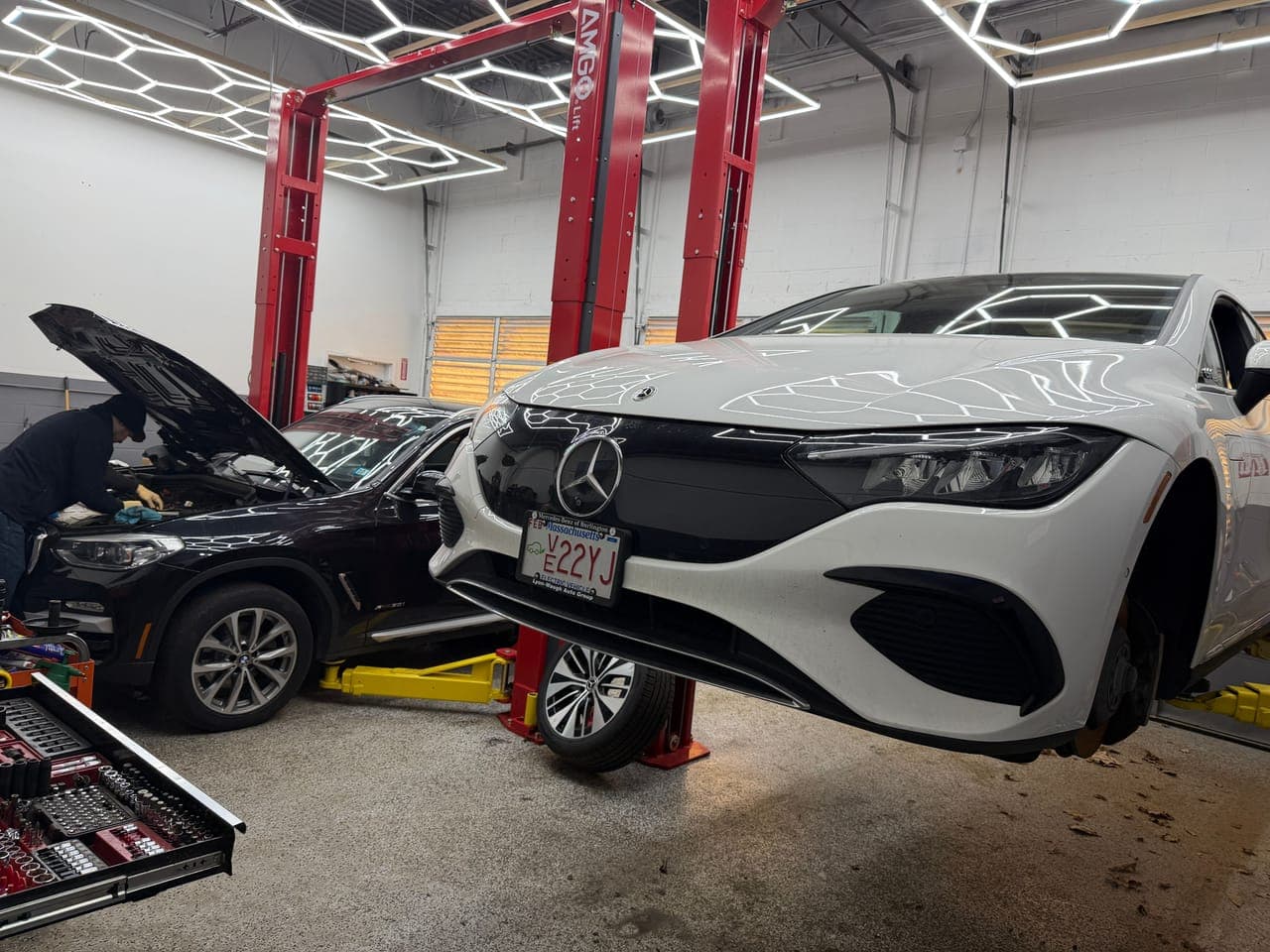
Cooling System
Running Hot or No Heat at All? Cooling System Repair in Manchester, NH
A temperature gauge climbing on I-93, or a heater blowing cold on the first frost — both trace back to the same loop of parts. Here's how a small cooling fault gets told apart from an expensive one, before anyone orders a part.
13 min readPro Tech Auto, Manchester NH
Two phone calls come in from opposite ends of the calendar. In August it's a temperature gauge creeping up on I-93 with the air conditioning running. In November it's a heater that blows cold the whole way to work. Different seasons, different complaints — and, more often than not, the same handful of parts. Cooling system repair in Manchester, NH covers both, because the loop that keeps your engine from cooking itself is the same loop that feeds your heater.
What makes this system worth understanding is that it doesn't fail politely. Brakes squeal for weeks. Struts go soft over a year. A cooling system tolerates a fault quietly right up until the afternoon it doesn't, and the failure waiting at the end is usually in a completely different price category than the fault that started it. This guide covers what the system actually does, how to read the pattern your car is showing you, what we test before quoting anything, and — honestly — which symptoms can wait until Thursday and which mean you should stop driving.
What your cooling system actually does
An engine turns most of the fuel it burns into heat rather than motion. The cooling system's job is to move that heat somewhere useful or somewhere harmless, and to hold the engine inside a narrow temperature band while it does it — hot enough to burn fuel cleanly and boil moisture out of the oil, cool enough that aluminum doesn't distort. Six parts share the work:
- Water pump — pushes coolant through the block, the cylinder head, and the radiator. On most engines it's spun by the accessory belt; on many European engines it's driven by the timing belt or chain instead, which changes the job entirely when it fails.
- Thermostat — a temperature-controlled valve that blocks flow to the radiator until the engine is warm, then opens. It's the reason your car warms up in five minutes instead of twenty.
- Radiator — the heat exchanger at the very front of the car. Air passing through its core pulls heat out of the coolant.
- Cooling fans — electric on nearly everything modern. They do the radiator's job when the car isn't moving fast enough to force air through it on its own.
- Hoses, pipes, and the expansion tank — the plumbing, plus the reservoir that gives coolant somewhere to expand into as it heats and contracts as it cools.
- Heater core — a second, much smaller radiator tucked behind your dashboard. Cabin air blows through it, and that is where your heat comes from.
That last one is the piece most drivers never connect. Your heater isn't a separate system with its own heating element — it's a tap off the engine's cooling loop. Which is why a cooling problem often shows up as a comfort problem months before it shows up as a temperature gauge problem, and why a heater blowing cold in October is worth taking seriously rather than living with.
Symptoms that mean your engine is running hot
"It's overheating" is where the conversation starts, not where it ends. When it happens tells us far more than the fact that it happens, so pay attention to the pattern before you call anyone — it's the single most useful thing you can bring us.
It creeps up in traffic, then drops once you're moving
That's an airflow problem. At speed there's enough air forced through the radiator to carry the heat away unassisted; sitting at a light on Elm Street there isn't, and the fans have to take over. If temperature climbs when you stop and falls when you move, we're looking at the fans, the circuit that commands them, or a radiator that's blocked on the outside — road grit, leaves, bugs, or a plastic air dam that got folded under on a curb.
It climbs on the highway but stays normal around town
The opposite pattern points at flow or capacity rather than airflow. Sustained load on I-93 generates far more heat than stop-and-go does, and a system that's marginal — a water pump moving less than it should, a radiator plugged internally, a thermostat that only opens partway, or a coolant level low enough that the pump is moving air along with liquid — will hold temperature fine at low load and lose the fight at 70 mph up a grade.
A sweet smell, white steam, or a puddle under the front
Coolant has a distinctly sweet smell, and it's the one fluid under the hood most people can identify by nose. Steam that smells sweet, a dried white or colored crust around a hose end or a radiator seam, or an orange, pink, or green puddle under the nose of the car all mean coolant is getting out. Note the color and roughly where the puddle sits — that's genuinely useful information when we go looking for the source.
The level keeps dropping and there's no puddle
This is the one that concerns us most, because coolant isn't consumed. An engine burns fuel and can burn a little oil; it does not use up coolant. If the expansion tank keeps falling and nothing is on the driveway, the coolant is leaving through a path you can't see — a head gasket letting it into a cylinder, an oil cooler letting it into the oil, or a heater core letting it into the carpet on the passenger side. All three need to be identified rather than assumed.
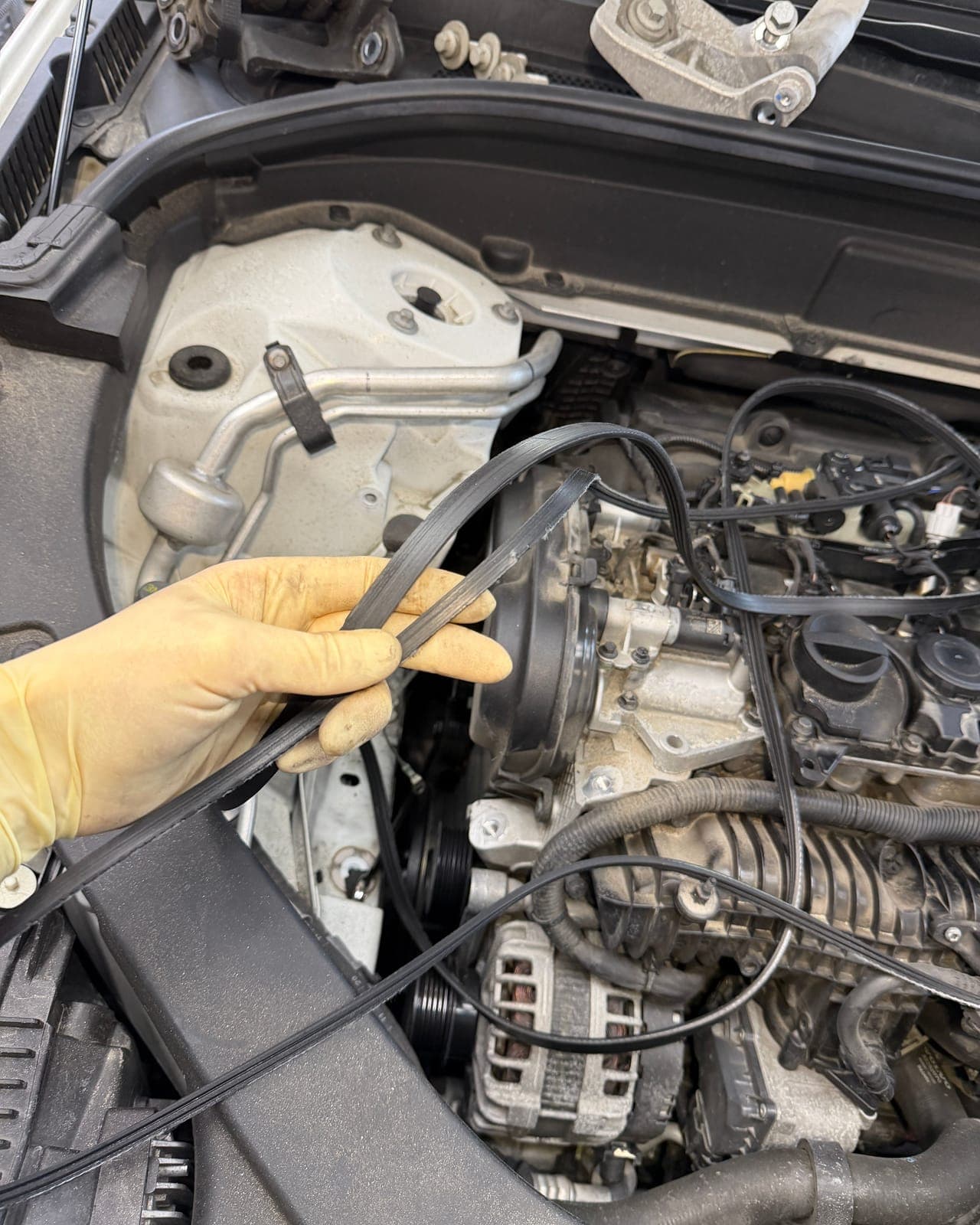
Why your car has no heat — and what that says about the cooling system
Now the November version of the call. Engine temperature looks normal, nothing is on the driveway, and the vents blow cold — or lukewarm at best — for the entire commute. Because the heater runs on engine coolant, a no-heat complaint is a cooling system complaint until proven otherwise. In rough order of how often we find them:
- Low coolant. The heater core sits high in the system, so it's the first thing to starve when the level drops. Heat that works at highway speed and disappears at idle is a strong hint. And low coolant means a leak somewhere — find it, don't just fill it.
- A thermostat stuck open. If the valve never closes, coolant circulates through the radiator constantly and the engine never reaches operating temperature. You get lukewarm air, worse fuel economy, and usually a stored code for coolant temperature sitting below the thermostat's regulating range.
- Air trapped in the system. Modern engines are full of high points that hold air pockets, and a pocket sitting in the heater core blocks flow through it. This is why a cooling system has to be filled and bled properly after any repair, not just topped off and handed back.
- A restricted heater core. Years of neglected coolant — or two incompatible coolants mixed together — leave deposits that plug the core's narrow passages. Both heater hoses hot at the firewall while the vents blow cold is the classic tell.
- A blend door or actuator failure. Sometimes it isn't the cooling system at all: it's the flap inside the dash that mixes hot and cold air, or the small motor that moves it. Repeated clicking behind the dash when you change the temperature setting is the giveaway.
The stuck-open thermostat deserves extra attention around here, because a short Manchester commute hides it beautifully. If your drive is ten minutes to a job downtown, the engine barely gets warm on a good day — so "the heat takes a while" never feels abnormal. Meanwhile the engine runs cold on every single trip: fuel washes past the rings instead of burning, moisture never boils out of the crankcase, and eventually the computer sets a code and turns on the check engine light. That's not only a comfort issue. A stored emissions fault will fail the electronic portion of a New Hampshire state inspection, and clearing the code doesn't help — it just resets the readiness monitors.
What we check first before quoting a cooling system repair
There are at least eight ordinary causes of an engine running hot and five of a heater blowing cold, and most of them share symptoms with each other. That's why we test before we recommend: parts swapped on a guess in this system are expensive, and a wrong guess frequently destroys the evidence that would have pointed at the right answer. Here's the order we work in.
- Ask when, not just what. Cold or warmed up? Idle or highway? Does the heat work? Once, or every time? Five minutes of questions narrows the list further than any single test does.
- Read the real temperature, not the gauge. Dashboard gauges on most cars are damped — they park dead center across a wide band so drivers don't panic over normal variation. We watch actual coolant temperature on the scan tool against the thermostat's rated opening point, and shoot the radiator, hoses, and block with an infrared thermometer to see where heat is and isn't moving.
- Pressure test the system, cold and hot. A hand pump on the expansion tank holds the system at operating pressure with the engine off, which makes a leak show itself instead of flashing off a hot exhaust manifold before anyone can see it. Some leaks only open up at temperature, so we test both ways.
- Watch the fans actually work. We command them on with the scan tool and confirm they run, at the right stage, at the right time — then look at what's sitting in front of the radiator. A cooling stack packed with road debris behaves exactly like a failed fan.
- Test for combustion gases when coolant vanishes without a puddle. A block test looks for exhaust gas in the coolant, which is how a head gasket gets confirmed rather than assumed. It's equally how we rule one out — and that matters, because "it might be the head gasket" is a sentence that talks people out of cars they didn't need to give up on.
- Check the coolant itself. Type, condition, and freeze protection. In New Hampshire the freeze point isn't a formality, and coolant that's been topped off with plain water for two summers can be sitting well above the temperature we actually hit in January.
- Write it down before anything is ordered. What we found, what it takes to fix, what it costs. Nothing gets replaced until you've seen that and told us to go ahead.
What it costs you to wait
Most wear items give you a long, forgiving warning period. The cooling system gives you a cliff. The gap between the cheap version of a repair and the expensive version is often a single hot afternoon, and the chains below are the ones we watch play out most often:
- A weeping water pump becomes a seized one. On a belt-driven pump, the bearing making a faint whine takes the accessory belt with it when it locks up — and now you have no coolant circulation, no alternator, and on many cars no power steering assist, all at once, usually in traffic.
- A small hose seep becomes an overheat. The system stops holding pressure, coolant's boiling point drops along with it, and a car that was fine all winter finds the first warm climb on Route 101 where it can't cope.
- A thermostat stuck open becomes an engine wear problem. Chronic under-temperature running dilutes oil with fuel and leaves condensation in the crankcase, which is exactly the environment that turns oil into sludge.
- A slow internal leak becomes a head gasket job. Coolant going somewhere it shouldn't — into a cylinder, into the oil — attacks bearings and rings while the car still drives more or less normally. By the time it runs badly, the repair has changed category.
- One real overheat becomes machine-shop work. Aluminum warps. A warped head has to come off and be resurfaced or replaced, which is the difference between a morning in the bay and your car being here for a week.

What New Hampshire does to a cooling system
Short cold commutes that never finish warming up
A ten-minute run from the West Side to downtown in February may never bring the engine fully up to temperature, especially behind a thermostat that's already getting lazy. The car spends its whole life warming up, which is the hardest duty cycle there is on oil, on the exhaust, and on the coolant. It also means a genuine cooling fault can hide for months, because nothing ever gets hot enough to expose it — and then the first long summer drive finds it all at once.
Road salt, and what it does to the plumbing
New Hampshire roads are salted from the first storm through the spring washout, and the cooling system's exposure is worse than most people assume. The radiator sits at the very front of the car taking direct spray off the road. Steel coolant lines, cooler lines, and the crimped seams where a radiator's plastic end tanks meet its aluminum core all corrode from the outside in. A radiator that lets go in July very often started letting go in March.
Summer load on I-93 and Route 101
The heaviest demand you ever place on a cooling system isn't simply a hot day — it's a hot day at sustained load with the air conditioning running, because the AC condenser sits directly in front of the radiator adding its own heat to the air the radiator has to use. Merging onto I-93 with a full car and the AC on is the exact moment a marginal system announces itself.
Freeze protection isn't optional here
Coolant is antifreeze for a reason, and the mix matters as much as the level. Repeated topping-off with plain water dilutes the mixture until its freeze point climbs into the range southern New Hampshire genuinely reaches in January. A cracked heater core or a split block from weak coolant is an entirely preventable failure — so we test the strength of what's in there, not just the height of it. That check rides along with the multi-point inspection on a routine maintenance and fluid service, which is the cheapest place to catch any of this.
European cars have their own cooling failures
If you drive an Audi, VW, BMW, or Mercedes, the parts are the same in principle and different in practice. Plastic thermostat housings and coolant flanges get brittle with heat cycles and split at the seams. Coolant crossover pipes on some V-engines run underneath the intake manifold, so a leak that's a twenty-minute job on a domestic four-cylinder turns into an intake-off repair. Many European water pumps are driven by the timing belt or chain rather than the accessory belt, which changes both the labor and the consequences of failure. Several use electric auxiliary coolant pumps that fail electrically, with no visible leak at all to point you at them.
None of that makes these cars unreliable — it makes them cars that need a shop willing to do the involved version of the job instead of turning it away. We go deeper on that side of the work in Audi and European auto service in Manchester, and the full mechanical menu — engine internals, timing chains, water pumps, valve covers — lives on the repairs page.
What can wait, and what can't
We'd rather tell you a repair can wait than have you doubt the next thing we say. So here's the honest split.
Usually fine to schedule for later this week
- A faint sweet smell after a long drive, with no drop in the expansion tank and a gauge that stays put.
- Heat that's slower to arrive than it used to be, on a car that otherwise runs at normal temperature.
- A dry, crusty coolant stain around a hose clamp that isn't wet to the touch.
- A cooling fan that sounds louder than you remember but still cycles on and off normally.
Get it looked at now — and don't drive it far
- Any movement of the temperature gauge above its normal resting position, even briefly.
- Visible steam, or a sweet smell strong enough to notice with the windows up.
- A coolant level that drops between fill-ups with nothing on the ground.
- A wet passenger-side floor, or a greasy film on the inside of the windshield that wipes away and comes back — both point straight at the heater core.
- Overheating that started suddenly on a car that was completely normal the day before.
- White smoke from the tailpipe that doesn't clear once the engine is fully warm.
If you're in the second list and you're within a few miles of the shop, drive it in with the heater on full — running the heater dumps engine heat into the cabin and can buy you the trip. If you're farther out, or the gauge is still climbing, call first and we'll talk honestly about whether it's worth a tow. That's a conversation, not a sales pitch.
We're a Manchester, NH auto repair shop that handles the whole mechanical menu, and cooling system repair sits right in the middle of it — the quick fixes and the involved ones other shops turn away. What doesn't change is the order of operations: diagnose it properly, explain what we found in plain language, and get your approval before anything is replaced. Serving Manchester, Bedford, Hooksett, Goffstown, Londonderry, and Derry — get in touch and we'll take a look.
FAQ
Cooling system questions Manchester drivers ask
01
Why does my car overheat in traffic but not on the highway?
That pattern almost always points at airflow rather than coolant flow. At highway speed there's enough air forced through the radiator to carry heat away without help, but in stop-and-go traffic the cooling fans have to do that job — so a failed fan, a fan control fault, or a radiator blocked on the outside by road debris only shows up once the car slows down. The opposite pattern, fine in town but hot on the highway, points instead at flow or capacity: a weak water pump, a radiator restricted internally, a partially stuck thermostat, or a low coolant level.
02
Why does my car have no heat but the engine isn't overheating?
Your heater is a small radiator fed by engine coolant, so it can lose flow long before the engine ever gets hot. The most common causes are a low coolant level (the heater core sits high in the system and starves first), a thermostat stuck open so the engine never reaches operating temperature, an air pocket trapped in the heater core, or a heater core plugged with deposits. It can also be the blend door or its actuator inside the dash, which isn't a cooling fault at all — which is exactly why the honest answer is to test it rather than guess.
03
Can I drive my car if it's leaking coolant?
Only carefully, and only a short distance. A leak means the system can't hold pressure, and coolant that isn't under pressure boils at a lower temperature — so a car that seems fine on a cool morning can overheat on the first warm afternoon or the first long climb. If the level is dropping or the gauge moves at all, treat it as a stop-driving situation. A single real overheat can warp an aluminum cylinder head, which turns a hose or thermostat repair into engine work.
04
How do you tell a bad thermostat from a bad water pump?
By testing, not by symptom alone, because both can produce an engine that runs hot. A thermostat is checked by comparing actual coolant temperature on a scan tool against its rated opening point, and by watching the temperature difference across the upper and lower radiator hoses as the engine warms up. A water pump is checked for bearing noise, shaft play, and seepage at its weep hole, plus flow and temperature behavior under load. On many European engines the pump is driven by the timing belt or chain, so confirming which part actually failed before anything comes apart matters a great deal to what the job costs.
05
Do I actually need a coolant flush, or is that an upsell?
Coolant does wear out. Its corrosion inhibitors deplete over time, and depleted coolant is what quietly eats water pump seals, radiator cores, and heater cores from the inside. Whether yours is due depends on the manufacturer's interval for your specific vehicle and coolant type, and on what the coolant actually tests at — not on a round mileage number a shop picked. We check condition and freeze protection during a routine service and tell you what we measured. If it doesn't need it, we'll say so.
Keep reading
More from the shop.
Fuel System
Fuel Injector Service in Manchester, NH: Symptoms, Cleaning, and When a Rebuild Beats Replacement
A rough idle, a hard start, or fuel economy that quietly slipped can all trace back to your injectors. Here's how to tell a dirty injector from a dead one — and when cleaning saves you the price of a whole new set.
Read post →Brakes
What Brake Repair Costs for Nashua Drivers: Pads, Rotors, and Full Jobs Explained
Why does one brake quote say $250 and the next $900 for the "same" job? Here's what pads, rotors, and a full brake job actually cost — and the common mistakes that quietly double the bill.
Read post →Maintenance
Why Regular Oil Changes Protect Your Engine (and Your Wallet) — A Manchester, NH Mechanic Explains
Oil changes look like a small line on the invoice. Skip them and you're rebuilding a top end. Here's what we actually see in the bay when intervals slip.
Read post →